
2027 Stellar Adventure at Camp Hi-Sierra
Campsites
Your troop’s home for the week: canvas tents on wood platforms under the pines, with flush toilets, water and a fire ring in every site.
A campsite in the pines
Every troop lives in its own campsite for the week. The program areas sit along the river, flat and close together. The campsites are up the hill above them, under tall pines and firs at 5,000 feet.
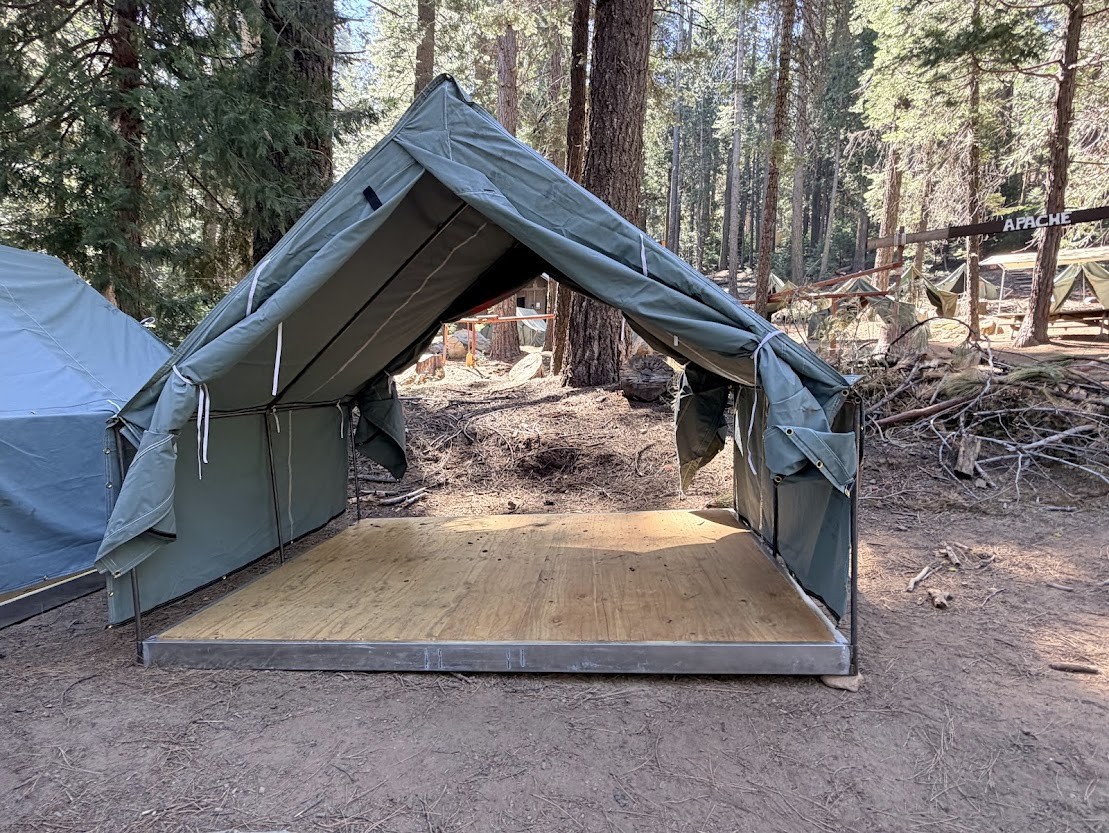
8 x 10 canvas tents on wood platforms. Bring a sleeping bag and pad. 56 new tent platforms went in for 2026.
A $750 deposit holds your troop’s campsite. Site preferences are first come, first reserved.
16 campsites
plus 6 extension sites for bigger troops
8 x 10 tents
Canvas, on wood platforms
2 flush toilets
In every campsite
$750 deposit
Holds your troop’s site
What’s in every campsite
The same set-up in every site, so your troop knows what to expect.
Tents
8 x 10 canvas tents on wood platforms.
Latrine
Two flush toilets.
Water
A hand-washing station, a drinking fountain and a hose.
Picnic table
With a rain fly over it.
Fire ring
With a broom, shovel and rake on the rack, and a fire jug.
Flagpole
Raise your troop’s American flag each day.
Patrol box
For supplies: spare trash bags, toilet paper and urinal screens.
Bulletin board
For the fire guard chart, duty roster and inspection form.
Your tent
A-frame canvas tents, about 8 by 10 feet, sit on raised wooden platforms with metal bases, about four inches off the ground. Troops don’t need to bring tents.
No cots, sleeping pads or bedding are provided. Bring a sleeping bag rated for 40°F or lower and a sleeping pad.
Two Scouts to a tent.
Units may bring extra tents, but flat space in the campsites is very limited.
Look your tents over when you move in and report any damage right away, so your troop isn’t charged for it. Don’t hang or tie anything to the tent frames. Tent repairs cost $10 per inch of damage, and a new tent costs $900.
Getting to your site
It’s uphill
Every campsite is uphill from the program areas. Lower sites like Blackfoot Heights are a short walk. Upper sites like Havasu can be 10 to 15 minutes uphill on a dirt road, a quarter to a half mile.
No cars at campsites
Vehicles stay in the parking lot all week. Stage your gear in the Flag Meadow, then use the camp’s carts and wagons to move it up the hill.
Pack light
Scouts carry their own gear to the campsite, so pack in a backpack or a bag with shoulder straps. No wheeled suitcases.
Staff help carry gear for anyone with a disability, and the easiest site to reach can be set aside for Scouts or adults with mobility needs. Ask the camp office before camp.
Reserving your campsite
$750 deposit
$750 campsite deposit per troop. It counts toward your total.
First come
Campsites are first come, first reserved. Tell us which site you’d like when you reserve.
Your own site
To guarantee your own site, your troop commits to 75% of the site’s capacity. Smaller troops may share or be moved at the Camp Director’s discretion.
Big troops
A troop bigger than its site can also reserve the site next door or an extension site.
Same site next summer
Reserve next year’s site while you’re at camp. Sign-ups open each Wednesday for troops in camp that week, and to every troop the next day. Troops in camp get first choice of their own site, and Adopt-a-Campsite troops get preference.
Reserving at camp also gets the lowest rate.
Sharing with another troop
Linked troops may share a site. Each troop makes its own reservation, pays its own $750 campsite deposit and brings at least two leaders.
Tents in each campsite
Apache
13 tents
Arapaho
16 tents
Blackfoot
19 tents
Chippewa
18 tents
Costanoan
11 tents
Delaware
10 tents
Havasu
8 tents
Hopi
10 tents
Maidu
16 tents
Miwok
11 tents
Navajo
11 tents
Nez Perce
13 tents
Paiute
10 tents
Saklan
10 tents
Sioux
17 tents
Yahi
11 tents
Extension sites
Apache Crest
13 tents
Blackfoot Heights
6 tents
Chippewa Manor
6 tents
Crossroads
8 tents
Havasu Hills
5 tents
Navajo Terrace
8 tents
Living in your campsite
Daily inspection
Commissioners inspect every campsite Monday through Friday. A perfect day scores 100 points.
Food
Food can come up to campsites for troop events but can’t stay overnight. Food needed for a medical reason can stay if it’s approved at check-in. Take food trash out before bed.
Medicines
The troop gives medications from the locked medical box in its campsite. The Health Lodge keeps refrigerated medications only.
Power and phones
Campsites have no electricity. Charge devices in the lock boxes outside the Trading Post or in the Dining Hall.
Showers
Two shower houses, north and south, with individual stalls. Adults may also use the showers by the Dining Hall.
Campfires
When CAL FIRE conditions allow. Don’t bring firewood: gather down wood around camp.
Quiet hours
Scouts are in their campsites by Taps at 10 PM. Quiet hours run 11 PM to 7 AM.
Trash
Tie full bags shut and take them to the dumpsters behind the Dining Hall.
Your campsite week
Sunday
After check-in, the health lodge and the swim check, your troop moves into its campsite and sets up.
Monday to Friday
Daily inspection. Keep the duty roster and inspection form posted all week.
Saturday
Cleanup starts at 8:30 AM: fold the tents, clean the site, staff inspection. Checkout by 10:00 AM.
Each troop is asked to take one shower-cleaning day. It’s voluntary, and it can count as a service project.
More campsite chances
Adopt-a-Campsite
Memorial Day weekend, May 28 to 30, 2027: level tent platforms, set up tents and get the sites ready for summer. From $20 per person, with a rocker patch.
Eagle Week
Scouts come on their own and camp in one of five camp troops, each with its own campsite. Tents are provided. June 27 to July 1, 2027.
Outside of summer
Families and groups can rent a campsite from $12.50 per person, per night, plus cabins and the dining hall.
Campsite questions
Will our troop share a campsite?
To guarantee your own site, your troop commits to 75% of the site’s capacity. Smaller troops may share or be moved at the Camp Director’s discretion. Site preferences are first come, first reserved.
Can I drive into the campsites?
Not at this time, but there are several parking lots within walking distance. If you need special assistance with carrying gear to your campsite, please let us know.
Can we bring our own tents?
Units may bring additional tents if needed, but flat space in campsites is very limited.
Are there wild animals around?
Yes! The Sierra Nevada Mountains are full of life from fish to birds, and even some mountain lions and bears. For this reason, we ask that you store your food in an animal-proof container away from where you sleep. Your car is also another good option. We also ask that you throw away your trash each night before bed, otherwise, you will have some unwanted visitors!
Where can Scouts charge phones?
Charging lock boxes are outside the Trading Post, and there are outlets in the Scoutmaster grotto and the Dining Hall. CPAP machines must be battery-operated; charge the battery in the locked area near the Trading Post (check out a key at the camp office).
Can Scouts bring bikes?
Yes. Scouts bring their own helmet, and bikes must be secured at the campsite.
Can we do a service project in our campsite?
Yes, with approval from your commissioner or the camp ranger first, and a project earns inspection bonus points. For a big project, or one you want to start before camp, email CHS@svmbc.org first. Projects for Adopt-a-Campsite weekend are due for review by May 1.
For leaders: The Perfect Campsite Unit Leadership at Camp 2027 Camp map
More about camp: Scouts Parents Dining Hall Where is Camp Hi-Sierra Resources